

Why do risk operations feel under control until volume exposes the cracks.
Because tools scale faster than decisions do.
iGaming operators invest heavily in risk engines, rules, and monitoring layers. These systems are essential, as they flag suspicious behaviour and enforce baseline controls. They work best when operating conditions stay predictable.
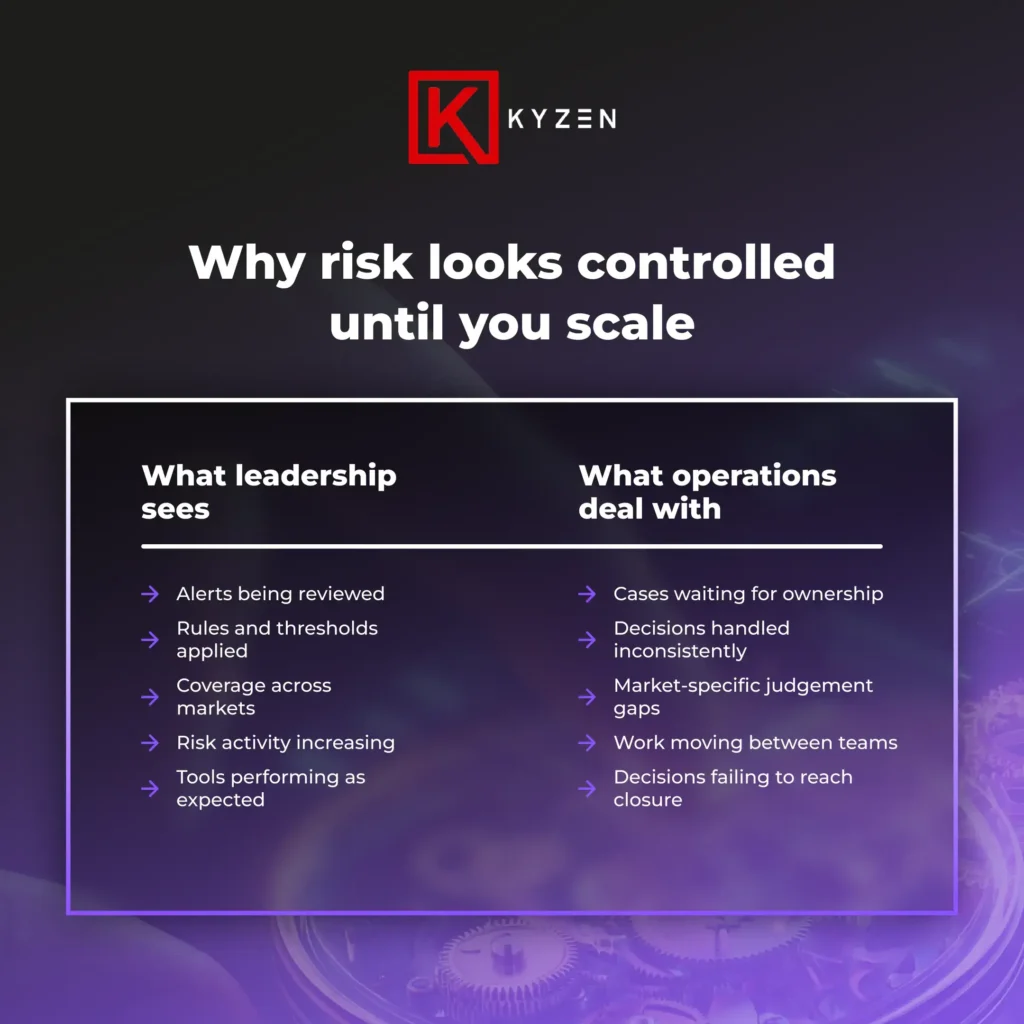
As those conditions change, new markets introduce unfamiliar behaviour. Payment flows grow more complex. Risk decisions begin moving across fraud, payments, support, and compliance instead of staying contained.
And that is where risk performance is shaped, by the decisions that never get closed.
When Risk Tools Stop Holding Up in Day to Day Operations
Risk platforms are built to recognise patterns based on known inputs. As operations scale, those patterns become harder to interpret in a consistent way.
Higher transaction volume introduces wider behavioural variation across markets. Payment methods respond differently under local regulation and banking constraints, and decisions that once closed cleanly now require additional context. Reviews slow down, and human judgement shifts from exception handling into everyday execution.
Operators usually respond by refining thresholds or adding new rules. That adjustment often restores balance for a short period. The pressure returns once volume increases further, because decision flow and ownership remain unchanged.
Inside operations, this pressure typically shows up as:
- Reviews staying open longer as case volume increases.
- False positives rising during new market launches.
- Manual decisions applied differently across teams and shifts.
- Similar cases reach different outcomes based on reviewer experience.
- Responsibility for resolution moving between teams without a clear owner.
These symptoms indicate that execution has not adapted to rising complexity.
Without an operational layer that manages prioritisation, context, and closure, risk tools generate more work without improving control.
What Automated Risk Tools Miss in Fraud Review
Fraud behaviour changes continuously, often faster than automated risk logic can be recalibrated in live iGaming operations.
Online gambling fraud activity increased by an average of 64 percent per year between 2022 and 2024. Higher transaction volumes and faster market expansion played a major role.
Early fraud rarely appears as a clear rule breach. It shows up through small behavioural shifts that only make sense when activity is reviewed over time.
Risk and fraud teams identify these shifts by looking beyond individual alerts, including:
- Changes in how players respond to friction during deposits or withdrawals.
- Deposit behaviour drifting away from established account history.
- Withdrawals that meet formal rules but conflict with overall player activity.
These signals are difficult to capture in automated models because they depend on context built across multiple events, not on isolated transactions.
Automated risk systems rely on historical data and fixed parameters. Fraud adapts while those parameters stay the same. As volume increases, reviews take longer to close and decision outcomes become less predictable.
An ownership based operating model keeps decisions with the case from signal to resolution. That continuity helps risk close before losses surface elsewhere.
Responsible Gaming Depends on Execution
Responsible gaming frameworks are clearly defined across regulated iGaming markets. Their real impact is determined by how consistently they are executed during live operations.
Triggers and thresholds indicate when an intervention should begin. Outcomes depend on execution speed, clear ownership, and consistent handling across teams. Delays or uneven responses increase regulatory exposure and weaken long term trust.
When ownership is unclear, responsible gaming actions start to fragment. Interventions are handled differently across markets and operating hours, and players receive mixed signals depending on which team responds. Over time, this inconsistency creates operational risk rather than reducing it.
Operators that treat responsible gaming as an operational control, not a compliance checkbox, see more stable outcomes.
This requires:
- Clear ownership of responsible gaming decisions from identification through resolution.
- Teams trained to assess behavioural patterns over time, and not only single thresholds.
- Direct coordination between risk, payments, and support during player interventions.
- Consistent decision standards applied across markets and shifts.
- Feedback loops that refine triggers based on intervention outcomes.
Where Ownership Breaks Inside Risk Operations
Risk operations often start to strain once work begins moving between teams rather than staying with a single owner.
A single case can pass through fraud review, payment processing, and customer support before it reaches resolution. Each function may act correctly within its scope. The problem appears when responsibility shifts between teams instead of remaining with one owner from the first signal to final closure.
As transaction volume grows, this fragmentation slows execution. Context fades during handoffs, decisions take longer to complete, and accountability becomes harder to trace.
Strong operational layers prevent these breakdowns by design, keeping responsibility intact as cases move through the operation.
They create:
- Clear ownership that follows each case from signal through resolution.
- Shared decision standards that reduce variation across teams and shifts.
- Direct feedback between reviewers and risk strategy to correct drift early.
- Faster case closure without weakening controls or increasing friction.
- More predictable outcomes as transaction volume increases.
Without this structure, tools continue to generate signals while execution slows down.
How Targeted Outsourcing Restores Execution Control
Maintaining consistent operational ownership internally becomes harder as scale increases, especially when complexity spreads across teams and markets.
Risk expertise is specialised, and transaction volume rarely grows in a predictable way. Market launches add pressure quickly, forcing internal teams to stretch across functions. Over time, ownership weakens even when staffing levels increase.
Targeted outsourcing works only when it restores execution responsibility rather than adding isolated capacity.
KYZEN operates as a single operational backbone across risk, fraud, payments, and support. Decisions follow one execution flow, with context staying attached to each case instead of being handed off between teams. This structure keeps ownership intact as volume increases.
Operators often begin with an operational audit, which highlights where execution slows, where handoffs break, and where tools stop converting signals into outcomes. From there, high volume workflows can be handled externally without sacrificing control or visibility.
The impact shows up in daily operations, with fewer handoffs, faster closures, and steadier execution as complexity grows.

