Why do AML programs feel heavier every year, even when teams grow?
Because the work has outpaced the way it is run.
Regulatory scrutiny has intensified as transaction volumes rise and market coverage widens. AML execution, however, still relies on fragmented teams and stretched reviewers. The strain stays hidden until volume makes it unavoidable.
The real test now is simple. Can AML carry operational load without slowing decisions, blocking payments, or spilling pressure across teams?
Operators often recognise the issue once it affects day to day execution.
How AML Actually Runs Inside Casino Operations
AML pressure no longer arrives through scheduled audits or isolated reviews. It runs continuously through day-to-day operations.
Transaction monitoring operates around the clock. Reviews build across markets. Escalations cut across payments, support, and risk at the same time. One delayed decision can pause withdrawals, trigger bank questions, or leave player accounts unresolved.
Regulators expect AML to function as a live operating system rather than a static framework. Expectations around consistency, traceability, and operational maturity rise as volumes increase. The focus is less on introducing new rules and more on how decisions move through your operation and reach closure.
When AML starts to strain, you see it in everyday execution. Review queues stay open longer than expected. Enhanced due diligence cases miss timelines. Reviewers struggle to close decisions because critical context sits outside the AML flow.
Why Operators Are Outsourcing AML Now
Operators are turning to AML outsourcing for one reason. Internal execution no longer holds when pressure builds.
Here is what starts to break first.
- Decision speed under load: Internal teams struggle to absorb new markets, payment methods, and shifting risk profiles without slowing outcomes. Reviews that once closed cleanly start taking longer as volume increases.
- EU regulatory judgement: EU focused AML demands practical familiarity with enforcement behaviour, banking scrutiny, and audit expectations. Generalist teams often apply judgement unevenly, which regulators and banks notice quickly.
- Execution continuity: AML depends heavily on experienced reviewers. When they leave, decision quality drops before issues surface in reporting or audits. Outsourcing reduces reliance on individual knowledge holders and keeps execution stable.
AML work does not pause as the business grows. Outsourcing allows operators to expand without rebuilding execution every time complexity increases.
What Operators Should Demand From AML Partners in 2026
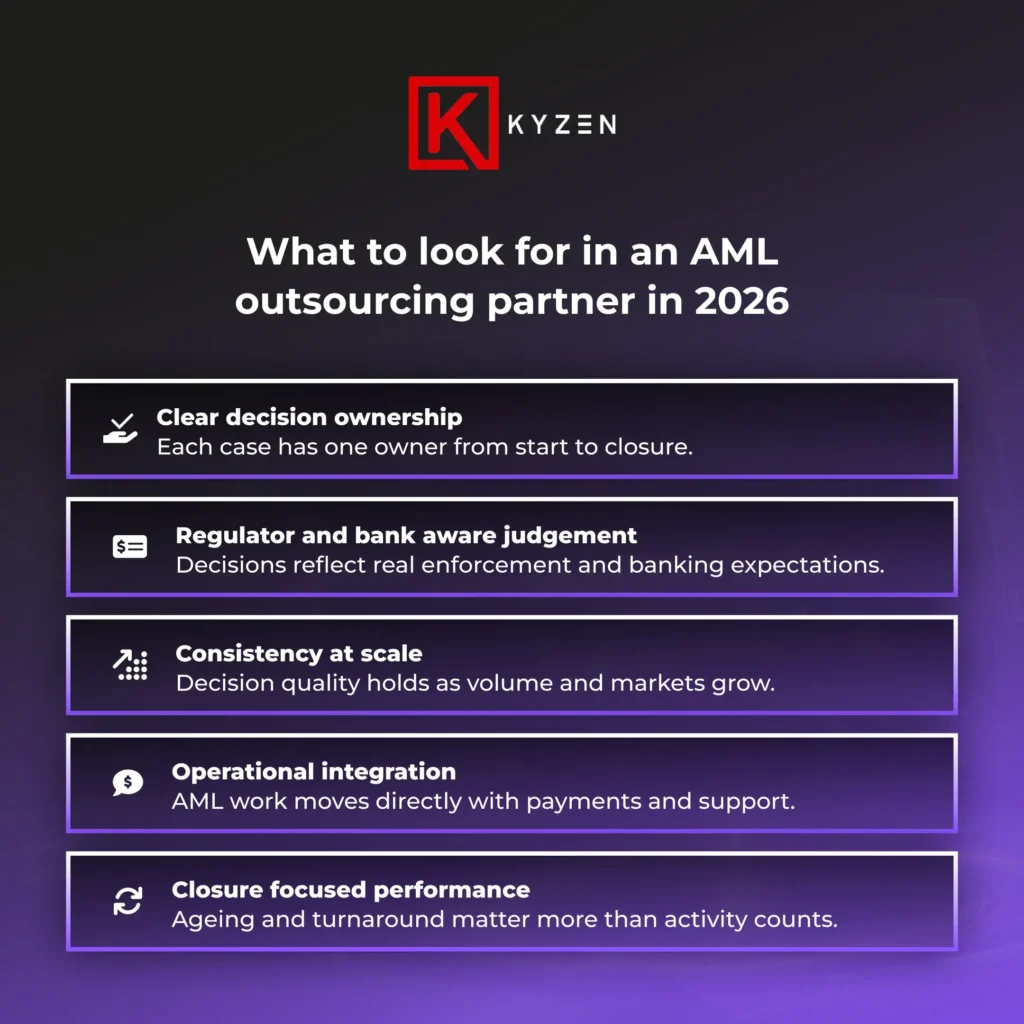
Not every AML provider solves the problem you actually have. In 2026, that gap shows up fast.
If you are trusting a partner with license and banking risk, you need clarity on a few non-negotiables.
EU regulatory fluency: Partners must operate with working knowledge of EU enforcement behaviour, banking scrutiny, and audit expectations as part of day-to-day delivery.
Scalable human execution: AML does not scale through automation alone. Review volumes change, and human judgement must expand without losing consistency or control.
Unified tech and decision flow: Risk signals and human decisions must move through the same operational path, with one team carrying responsibility from detection through closure.
Clear performance ownership: Review turnaround, escalation ageing, and audit readiness should be tracked as live execution signals, not after-the-fact summaries.
Built-in flexibility: AML scope shifts with markets and risk profiles. Partners must adapt coverage and processes without locking you into rigid models.
These requirements define the kind of partner that operates inside execution, rather than supplying capacity at the edges.
Red Flags That Signal Future AML Failure
The warning signs are rarely hidden. You see them in daily execution if you know what to watch for.
Look closely for these patterns:
- AML coverage that stops outside business hours leaves reviews open and work piling up overnight.
- Reviews without a named decision owner drift between teams and lose accountability.
- Generic AML playbooks fail to reflect how EU regulators and banks actually enforce decisions.
- Reporting that counts activity instead of resolution masks where execution is slowing.
- Escalations moving between AML, payments, and support point to a breakdown in operational flow.
By the time these patterns become visible in audits or bank conversations, pressure has already moved beyond AML.
Why KYZEN Fits the 2026 AML Operating Model
AML execution weakens when ownership is split across teams. KYZEN is built to keep responsibility clear and contained.
KYZEN runs AML as part of a wider operational backbone across payments, risk, and support. Reviews are handled within a single operational path. Decisions carry context from the first signal through to final resolution.
The model is human led and EU specialised. KYZEN teams handle KYC, sanctions screening, PEP checks, enhanced due diligence, and audit readiness as live operational work. Escalations follow defined routes. Decisions close where accountability sits.
This structure supports execution beyond basic compliance. It helps maintain stable banking relationships and license confidence as operational pressure increases.