
Business process outsourcing (BPO) is the practice of contracting an ongoing business function, such as customer support, finance, payment operations, compliance administration or HR, to a third-party provider instead of running it entirely in-house. The provider takes responsibility for executing the agreed process while the client keeps strategic oversight. Specialist providers such as KYZEN focus on operational functions where industry knowledge matters.
This guide explains how BPO works in practice, the main ways providers are classified, the genuine benefits and risks, how AI is changing delivery, and how pricing, SLAs and exit clauses shape a real BPO contract.
What Is BPO?
At its simplest, BPO means handing over a defined, repeatable business process rather than buying help with isolated tasks. That distinction matters.
A provider running standard support services is not simply answering extra tickets during a busy week. It may take responsibility for staffing, training, quality monitoring, escalations, reporting and day-to-day service delivery against agreed standards.
Because the engagement is continuous, the provider becomes part of the operating model rather than a short-term project resource. The business still owns its customer relationships, strategy and key decisions, while the external team executes the outsourced workflow under agreed controls.
How Does BPO Work?
BPO usually starts with a business identifying a process that can be transferred without giving up strategic control. It then evaluates providers with relevant functional and industry expertise and agrees a contract covering scope, responsibilities, service levels, reporting, data handling and commercial terms.
After onboarding, the provider assigns a dedicated team or uses an agreed shared-service model, depending on the engagement. That team connects to the client’s existing systems, learns the required workflows and takes over daily execution.
The client continues to set priorities, review performance and make strategic decisions, while the provider manages the outsourced operation against the agreed measures.
Types of BPO
BPO is commonly classified in two different ways: by where the outsourced work is performed and by what type of business function is being outsourced. Both matter when comparing providers because location affects factors such as time zones and cost, while service type affects expertise, controls and customer impact.
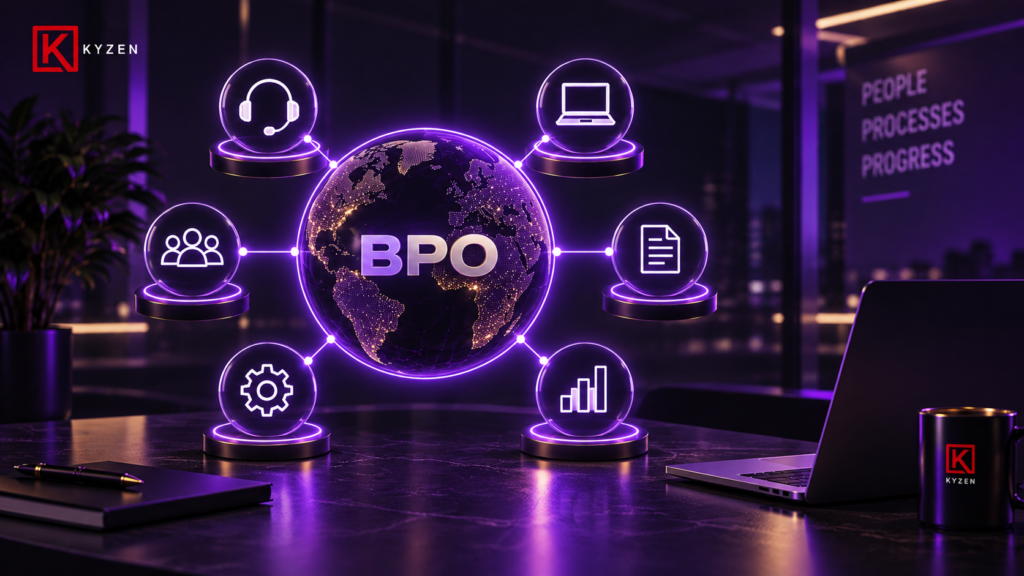
BPO by Location — Offshore, Nearshore, Onshore
Offshore BPO moves work to a provider in a more distant country, often to access lower operating costs or a larger talent pool. Nearshore BPO uses a provider in a nearby country or region, which can reduce time-zone and communication friction while retaining some cost advantage. Onshore BPO keeps the outsourced work within the same country, often prioritising cultural familiarity, regulatory alignment and proximity.
The right model depends on the process. A 24/7 multilingual support function may benefit from distributed coverage, while work that demands close local knowledge or frequent real-time collaboration may favour nearshore or onshore delivery.
BPO by Service Type — Back Office vs Front Office
Back-office BPO covers internal functions that usually do not involve direct customer contact. Examples include payroll, bookkeeping, data entry, accounting support, IT administration and compliance administration.
Front-office BPO covers functions that interact directly with customers or prospects, such as customer service, technical support, sales and telemarketing.
Many businesses use both. Back-office outsourcing is often driven by efficiency, specialist capability and cost control. Front-office outsourcing requires closer scrutiny because the provider directly influences customer experience, response quality and brand perception. The two can also interact. A support agent, for example, may depend on back-office verification, billing or compliance workflows to resolve a customer case correctly.
Common Tasks and Functions Suited to BPO
Businesses outsource a wide range of repeatable operational functions, including:
- customer service and technical support
- finance and accounting tasks such as invoicing, bookkeeping and payroll
- IT support and infrastructure administration
- HR functions such as recruitment support, onboarding and benefits administration
- compliance administration
- payment operations and fraud monitoring
Payments require careful terminology. Regulated payment processing and the movement of customer funds may remain with authorised payment providers, while a BPO specialist supports the surrounding operational work, such as transaction review, payment-method integrations, PSP coordination, routing, performance monitoring and fraud controls.
For iGaming operators, Kyzen’s payment solutions are an example of this operational layer, covering market assessment, PSP sourcing, onboarding support, payment coverage and ongoing performance management across complex payment environments.
BPO Call Centers
BPO call centers are one of the most familiar forms of business process outsourcing. They handle inbound or outbound customer communication as an ongoing function rather than temporary overflow support. Depending on the operation, this can include multilingual service across time zones, tiered escalation for complex cases and performance tracking against measures such as first response time and resolution time.
This model is especially relevant to businesses operating around the clock. For an iGaming example, the requirements outlined under our standard casino support reflect the need to maintain consistent assistance while player activity, deposits, withdrawals and account queries continue across different markets and time zones.
Benefits and Advantages of BPO
BPO can lower operating costs, provide specialist capability and free internal teams to focus on higher-value priorities. Those benefits are not automatic. They depend on outsourcing the right process, choosing a provider with the right expertise and managing the relationship with clear responsibilities, reporting and performance standards.

Cost Savings
Outsourcing can reduce the cost of building and maintaining an in-house team for a specific function. Instead of recruiting, training, managing and retaining every specialist internally, a business pays for an agreed external service.
This can turn part of a fixed staffing burden into a more flexible operating cost. Savings may be greater where the function requires specialist technology, management layers, 24/7 coverage or expertise that would be expensive to build from scratch.
Freeing Up Time for Core, Strategic Work
Operational work can consume significant management attention even when it is not what differentiates the business. Outsourcing selected processes allows internal teams to focus more heavily on areas such as product development, strategy, commercial growth and customer proposition.
The goal is not to remove responsibility, but to avoid using senior or specialist internal resources on day-to-day execution that a capable external team can manage effectively under clear oversight.
Reduced Compliance Risk
A specialist BPO provider can reduce operational compliance risk by bringing established processes, trained staff and experience with the regulatory requirements relevant to the outsourced function. That capability can be costly to reproduce internally, particularly in highly regulated sectors.
However, outsourcing does not automatically transfer a company’s legal or regulatory responsibilities. The benefit depends on selecting a provider with genuine, verifiable expertise, defining responsibilities clearly and maintaining appropriate oversight throughout the engagement.
Access to Specialised Expertise and Technology
BPO providers often maintain specialist staff, operational tooling and management processes that would be inefficient for one business to build independently. This is particularly useful in areas such as fraud detection, risk operations and payment orchestration, where performance depends on continuous monitoring and refinement.
A specialist provider may also bring experience gathered across many operational environments. That broader perspective can help teams identify recurring issues and proven approaches without implying that confidential client data is shared between engagements.
BPO and AI
AI is changing how BPO teams divide work between automation and people. In customer service, AI can answer common questions, classify requests, route tickets and collect context before a human takes over. Behind the scenes, machine-learning systems can also help risk teams flag unusual behaviour or transaction patterns for review faster than purely manual processes.
This pressure is particularly visible in crypto casino operations, where high transaction volumes, fast-moving player activity and the finality of some crypto transfers can increase the cost of late intervention.
The strongest operating model is rarely “AI instead of people”. Automation is well suited to volume, repetition and initial detection. Human specialists remain important for ambiguous cases, judgement calls, escalations and relationship-sensitive interactions.

Risks and Challenges of BPO
Outsourcing creates real trade-offs as well as benefits. A third party becomes responsible for part of the business’s day-to-day operation, so poor provider selection, weak contracts, non-established KPIs or limited oversight can introduce new risks. A sound BPO decision should assess those risks as carefully as potential cost or efficiency gains.
Data Privacy and Security Risks
A provider can only run a process if it has access to the information needed to perform it. Depending on the function, that may include customer records, payment-related information, identity documents or internal business data. This creates additional privacy and security exposure.
Due diligence, access controls, contractual safeguards, data-processing terms and ongoing security reviews can reduce the risk, but not remove it entirely. Provider evaluation should therefore examine security practices, incident procedures and data governance rather than relying on a certificate alone.
Loss of Control and Service Quality
BPO reduces direct day-to-day control because another organisation is executing the process. Without clear standards and active monitoring, service quality can drift from what the business expects or would deliver internally.
The risk is particularly visible in customer-facing functions. Slow responses, poor escalation handling or inconsistent communication are experienced directly by customers and can affect trust in the brand. Clear quality measures, regular reviews and defined escalation routes help keep the outsourced operation aligned with internal expectations.
Process and Communication Misalignment
A provider that lacks context about the client’s product, customers or internal decision-making can create friction quickly. Common problems include misunderstood procedures, slow escalations, duplicated work and decisions made without information the internal team would normally use.
Specialisation can reduce this risk. A provider experienced in a sector such as iGaming already understands much of the terminology, operating rhythm and common failure points, which shortens the learning curve. It still needs proper onboarding and client-specific training, but it is not starting from zero.
How to Choose a BPO Provider
Start with relevant industry and functional experience. A specialist provider like Kyzen that already understands a variety of sectors such as iGaming and Forex, may be better equipped for complex sector-specific workflows than a generalist learning them for the first time.
Next, check technology and integration capability. A provider should be able to work effectively with the systems you already use unless there is a clear reason to change them.
Then examine reporting and transparency. You need regular visibility into performance, incidents, trends and unresolved issues. Finally, ask for references or evidence tied to the same industry and function you plan to outsource, rather than relying only on broad testimonials.
How BPO Contracts Are Actually Structured — Pricing Models, SLAs, and Exit Clauses
A BPO contract needs to define more than the service itself.
Pricing may be volume-based, such as a fee per interaction or transaction; FTE-based, where the client pays a set amount for each dedicated full-time-equivalent role; or outcome-based, where part of the fee is tied to agreed results. Outcome pricing works best when performance can be measured and attributed fairly.
Service level agreements (SLAs) set measurable commitments such as response times, resolution times, monitoring coverage, escalation windows or reporting frequency. In a specialised function such as payment orchestration management, acceptance rates may be monitored as an important performance indicator, but contracts should recognise that PSPs, acquirers, issuers and transaction mix can also affect the result.
Exit clauses should cover notice periods, transition support, data return or deletion, access removal and handover obligations. These terms matter before problems arise, not only when the relationship ends.
Frequently Asked Questions
What is BPO in simple terms?
BPO means hiring a third-party specialist to run a specific ongoing business function instead of managing the whole process in-house. The outsourced provider handles agreed day-to-day operations, while the business keeps strategic oversight, accountability and control over the wider organisation.
What’s the difference between BPO and generic outsourcing?
BPO refers specifically to outsourcing a complete, ongoing business process. Generic outsourcing is broader and can include individual tasks, freelancers or one-off projects. Hiring a firm to run customer support continuously is BPO; commissioning a single software project is outsourcing, but not necessarily BPO.
What is a BPO call center?
A BPO call center is an external provider that manages customer communication on behalf of another business as an ongoing service. It may handle customer support, sales or technical queries across phone, chat and email, with agreed staffing, escalation and performance standards.
What are the main types of BPO?
BPO is usually classified by location and by service type. Location-based models are offshore, nearshore and onshore BPO. Service-based models divide work into back-office functions, such as payroll or accounting support, and front-office functions, such as customer service and sales.
Is BPO only about cost savings?
No. Cost reduction is only one reason businesses use BPO. Other important drivers include access to specialist expertise and technology, faster scaling, round-the-clock coverage and giving internal teams more time to focus on strategy, product development and other core priorities.
What should be included in a BPO contract?
A BPO contract should clearly define the pricing model, measurable service levels and exit terms. It should also make scope, responsibilities, reporting, data handling and transition obligations explicit, so both parties know how performance is measured and what happens if the engagement changes or ends.

