
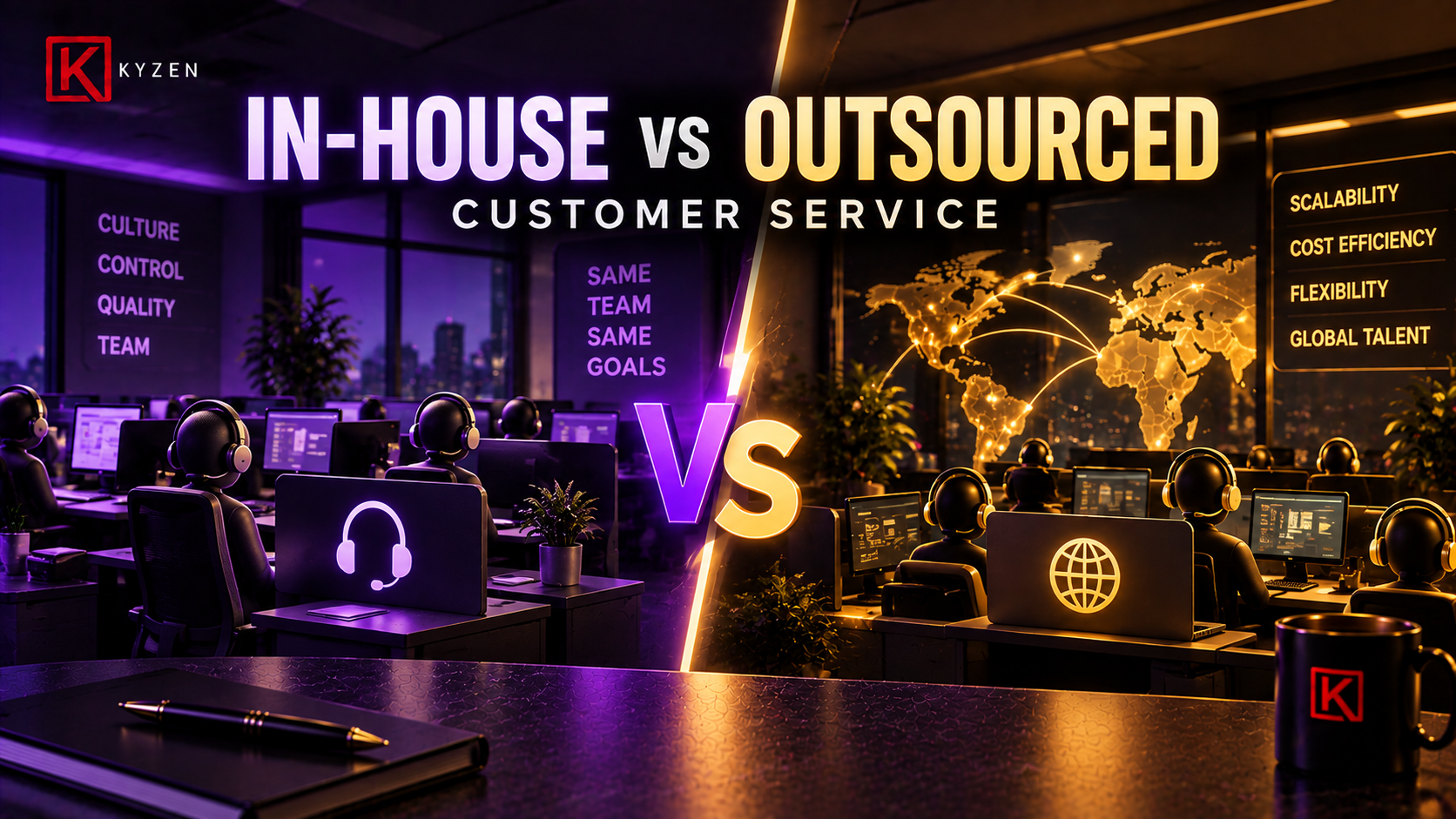
In-house vs outsourced customer service is not a choice with one right answer for every business. An internal team gives you tighter control and deeper day-to-day product knowledge, while outsourcing can make specialist expertise, flexible capacity, and extended coverage easier to access. Providers such as KYZEN specialize in operational support where industry knowledge matters.
This guide looks beyond the headline cost comparison to examine how both models work, what businesses often overlook, where in-house genuinely has an advantage, and how the decision changes when compliance and complex operations enter the picture.
What Each Model Actually Means
In-house customer service means recruiting, training, and managing your support team internally. Your business owns the staff, systems, processes, quality management, and day-to-day operation.
Outsourced customer service moves some or all of those responsibilities to an external provider. A managed standard support operation, for example, can cover staffing, multilingual support, training, quality monitoring, escalation handling, and reporting.
The choice is rarely completely binary. Some businesses keep all support internally, some outsource the full function, and many use a hybrid model where internal and external teams handle different types of interactions.
Which Businesses Suit Which Model
Your company stage, contact volume, operating hours, and product complexity are useful starting filters.
Outsourcing tends to fit businesses with stable processes, growing volumes, or demanding coverage requirements. In-house support becomes more attractive when conversations rely heavily on institutional knowledge or the support team remains closely involved in shaping the product itself.
Signs Outsourcing Is the Better Fit
Outsourcing becomes worth serious consideration when support demand is growing faster than your recruitment process can handle.
Other strong signals include:
- customers need evening, weekend, or 24/7 coverage
- adding internal headcount is becoming difficult to justify
- multiple languages are required
- contact volumes fluctuate significantly
- support processes are mature and well documented
- much of the workload is repeatable
- you need specialist operational knowledge that is difficult to recruit internally
When those issues are already creating pressure, understanding how to outsource effectively becomes more useful than simply asking whether an external team is cheaper.
Signs In-House Is the Better Fit
In-house support can be the stronger choice when your business is still defining how customer service should work.
An early-stage company may change its product, policies, and support processes weekly. Keeping agents close to product and leadership teams can make that feedback loop faster.
The same applies to highly bespoke or technical products where good support depends on years of accumulated context that is difficult to document.
Internal ownership can also make sense when customer conversations are a major source of product intelligence. If separating agents from engineers, product managers, or founders would slow learning and decision-making, the strategic cost of outsourcing may outweigh the operational benefits.
Cost Comparison
Cost is often the first comparison businesses make, but agent salary versus provider fee is rarely enough to produce a useful answer.
An internal operation carries recruitment, systems, management, and capacity costs that sit outside base pay. Outsourcing has its own onboarding, governance, and transition expenses.
A fair comparison therefore needs to look at total operating cost, not the most visible line item.

Fixed Costs of Building In-House
An internal team starts accumulating costs before the first customer conversation is handled.
Beyond salaries, businesses may need to pay for:
- recruitment and hiring
- employee benefits
- support software licenses
- communication tools
- laptops and other equipment
- remote-working or office infrastructure
- training development
- team leaders and managers
- workforce planning
- quality assurance
- reporting and analytics
Some of these costs increase gradually as the operation grows. Others require investment before additional capacity becomes productive.
The more complex the support environment, the more layers tend to appear around each customer-facing agent.
Hidden Costs of In-House Teams
The less visible costs can materially change the comparison.
Staff turnover creates another recruitment and training cycle. New agents need time before reaching full productivity. Managers also spend hours forecasting demand, reviewing performance, resolving staffing issues, and maintaining training.
There is an opportunity cost too. Every hour senior leadership spends solving a scheduling or recruitment problem is time not spent on product, growth, or strategy.
Capacity creates another challenge. Internal teams are difficult to resize quickly. A sudden increase in demand can leave you short-staffed, while a later decline can leave you carrying unused capacity.
Hidden Costs on the Outsourcing Side
Outsourcing has costs beyond the monthly invoice as well.
Processes need to be documented. System access has to be configured. Agents require training, testing, and calibration before taking significant volumes. Service quality can also dip temporarily during ramp-up.
Once live, someone internally still needs to manage the provider, review reporting, handle escalations, and make sure operational knowledge stays current.
Specialist outsourced functions can introduce their own commercial considerations too. For example, businesses trying to manage payment costs may need to consider PSP commercial terms, onboarding effort, and market-specific payment coverage alongside the cost of the operational support itself.
Outsourcing removes work from your team. It does not remove the need for governance.
A Worked Cost Example
Rather than relying on a generic industry average, build the comparison using your own operating assumptions.
Imagine you need five agents covering standard business hours.
For the in-house model, calculate:
Agent salaries + benefits + recruitment + software + equipment + training + management + QA + expected turnover costs
For the outsourced model, calculate:
Provider fees + onboarding + integration + internal vendor-management time + any additional software or specialist charges
Then model what happens if volume rises by 25%, operating hours expand, or another language becomes necessary.
That final step often changes the result. A model that appears cheaper at today’s volume may become expensive once capacity has to expand. Actual costs vary significantly by market, provider, sector, and service scope, so use current figures from your own operating environment rather than generic online averages.
Onshore, Offshore, and Delivery Models
Choosing to outsource creates a second decision: where and how should the outsourced operation be delivered?
A provider may be onshore or offshore, while either an internal or external support team can operate from one central location or be distributed across multiple time zones.
These choices affect cost, communication, coverage, and access to suitable talent.

Onshore vs Offshore Outsourcing
Onshore outsourcing keeps your provider in the same country or primary market. It can make cultural, linguistic, and regulatory alignment easier, but labor costs are often higher.
Offshore outsourcing uses teams in other countries, commonly to access lower operating costs, larger talent pools, or better coverage across time zones. The trade-off can be greater cultural distance, more complex communication, and additional due-diligence requirements.
For sectors such as iGaming, the decision needs more scrutiny. A business evaluating crypto casino support, for example, should consider language capability, payment familiarity, and compliance awareness alongside labor cost.
Forex operators face similar questions when customer conversations involve account verification, payments, or other sensitive workflows.
Distributed vs Traditional (Centralized) Support
A traditional centralized team operates primarily from one location. That can simplify supervision, training, and communication, particularly when everyone works similar hours.
A distributed support model deliberately spreads agents across locations or time zones. This can extend service hours and reduce dependence on a single site or shift pattern.
The distinction applies to both models. An in-house company can employ remote teams across several markets, while an outsourcing provider can run one centralized operation.
The important question is whether your delivery structure supports customer demand without making management, communication, and quality control unnecessarily complicated.
Control, Quality, and Brand Fit
Control is where the strongest case for in-house support usually starts.
Internal managers can intervene directly, agents operate closer to the company, and product knowledge develops naturally over time. For businesses where casino support quality can influence player trust and retention, those advantages deserve serious weight.
Outsourcing can narrow the gap, but it requires deliberate management.
Maintaining Quality Control
Quality is structurally easier to observe when the team works directly for you.
Managers can listen to conversations, coach agents immediately, and change processes without coordinating through another organization. When the support team is external, there is an additional operational layer between the business and the agent.
Transparent reporting, quality audits, and regular calibration sessions can reduce that distance considerably.
Still, outsourcing requires trust in the provider’s management systems. You need enough visibility to detect declining CSAT, rising escalations, or inconsistent responses before customers begin feeling the effect.
The goal is not simply to receive reports. It is to retain enough operational visibility to act.
Brand Knowledge and Customer Experience
A long-serving internal agent often develops a level of product and brand understanding that is difficult to reproduce quickly.
They learn how customers talk, which edge cases recur, and what a particular complaint may really mean. Shared outsourcing teams can struggle to build the same depth when agents divide their attention across several accounts.
That risk can show up subtly through generic responses, inconsistent tone, or answers that are technically correct but miss the customer’s real concern.
Dedicated teams, specialist providers, and strong knowledge management can narrow the gap significantly. Outsourcing works best when external agents are treated as an extension of the operation rather than a separate ticket-processing function.
Speed, Scalability, and Coverage
Outsourcing generally has its clearest structural advantage when demand changes quickly.
An internal team can only grow as fast as the business can recruit, onboard, and train suitable employees. An established provider may already have recruitment pipelines, workforce planning processes, and management capacity that make expansion faster.
Coverage creates another difference. Extending an internal operation from office hours to 24/7 means building several shifts, adding supervision, and maintaining enough redundancy to cover leave or absence.
A provider designed for continuous operations can spread those requirements across a larger infrastructure.
This matters most for businesses operating across markets and time zones, where customers do not organize their problems around the company’s office hours.
Technology and Tooling
Internal teams give you complete control over the technology stack, but your business also has to choose, implement, license, and maintain it.
An experienced outsourcing provider may already work with established customer-service platforms, QA systems, workforce tools and integrations. More specialized providers can also bring operational knowledge around systems outside the traditional support stack.
In iGaming, for example, payment orchestration may involve ongoing management of platforms such as PaymentIQ, Praxis, Corefy or PayControl. KYZEN supports the operational management and optimization of these environments rather than supplying the underlying payment platform itself.
That distinction matters. The value comes from specialized operational expertise around the client’s technology, not simply owning more software.
How AI Is Changing the Cost Equation
AI is changing both sides of the comparison.
Routine inquiries can increasingly be classified, routed, or answered without requiring the same amount of agent time. That can lower the headcount needed by an internal team and reduce the volume an outsourcing client needs humans to handle.
The economics depend on implementation. A business building internally must choose technology, integrate it, maintain knowledge, and monitor output quality. An established provider may spread similar investments across several client operations, potentially making efficiencies available faster.
But lower interaction cost is not the only measure that matters. Teams still need to track customer support KPIs such as CSAT, customer effort, resolution quality, and reopen rates to make sure automation is reducing genuine workload rather than simply hiding it.
Pros and Cons of Each Model
The differences become clearer when the trade-offs sit side by side.
Neither model wins across every dimension. In-house support usually gives you greater control and deeper internal context, while outsourcing tends to offer stronger scalability, coverage flexibility, and access to specialist operating capability.
Pros and Cons of Outsourcing
Advantages:
- potentially lower total operating cost at scale
- faster team expansion
- easier access to multilingual talent
- round-the-clock coverage
- established recruitment and training infrastructure
- access to specialist operational expertise
- less internal management burden for day-to-day delivery
Disadvantages:
- less immediate operational control
- possible product and brand knowledge gaps
- onboarding and transition costs
- dependence on the provider’s reliability
- additional third-party data and access considerations
- ongoing vendor-management requirements
The quality of outsourcing depends heavily on the provider, operating model, and level of client involvement.
Pros and Cons of In-House
Advantages:
- direct management control
- stronger day-to-day connection with the wider business
- deep product and brand knowledge
- faster internal feedback loops
- easier real-time intervention
- less dependence on a third-party provider
Disadvantages:
- higher fixed operating costs
- slower recruitment-driven scaling
- more management overhead
- greater exposure to turnover and rehiring costs
- more difficult 24/7 coverage
- responsibility for maintaining all training, tooling, and infrastructure internally
For stable, highly specialized operations, the advantages can justify the additional cost. For rapidly scaling support functions, the constraints become more noticeable.
Hybrid and Blended Models
You do not have to choose one model for every customer interaction.
A hybrid operation can keep complex, sensitive, or highly brand-specific work inside the business while outsourcing routine queues, overflow demand, selected languages, or after-hours support.
An iGaming operator might retain certain high-value or sensitive escalations internally while an external team handles standard account and service queries. Another business may use its internal agents during core hours and outsource overnight coverage.
This is not necessarily a temporary compromise. It can be a deliberate operating model.
The split should follow interaction complexity, risk, and required context, rather than an arbitrary percentage of total ticket volume.
Choosing the Right Partner
If outsourcing appears to fit, evaluate potential providers against the work you actually need them to perform.
Ask:
- Do they have verifiable experience in your industry?
- Have they handled the same type of customer interactions before?
- Can they work within your existing systems?
- How do they train and calibrate agents?
- What reporting will you receive?
- Can you see performance at a useful level of detail?
- How are escalations handled?
- How are access and sensitive data controlled?
- Can they provide relevant references or case evidence?
- What happens if service quality begins to fall?
A provider’s general customer-service credentials matter less than proven capability in your specific operating environment.
A Quick Decision Framework
Use these questions as a first filter:
Is support volume growing faster than you can recruit?
If yes, outsourcing gains an advantage.
Do customers need extended or 24/7 coverage?
Outsourcing may make the staffing model easier to sustain.
Can you comfortably fund recruitment, training, management, and infrastructure internally?
If not, compare the outsourced total cost.
Does excellent support require deep institutional or product knowledge that takes years to develop?
In-house or hybrid delivery deserves stronger consideration.
Is the support function compliance-sensitive?
Compare the expertise of your internal team with that of specialist providers rather than assuming internal automatically means safer.
Are your processes documented and stable enough to transfer?
If not, improve them before outsourcing at scale.
The answer does not have to be all or nothing.
Why the Calculus Changes Once Compliance Enters the Picture
Regulated sectors add another question: where can the required expertise be maintained most reliably?
Understanding what BPO means is useful here because outsourcing can cover complete operational processes, not merely additional staff.
In iGaming, first-line support may encounter KYC queries, AML-related account restrictions, responsible gambling concerns, and payment disputes. Forex teams can similarly receive verification, funding, withdrawal, and other compliance-sensitive inquiries. The precise obligations differ by jurisdiction and business model.
An internal team offers control, but control has little value if the business cannot recruit, train and retain people with the necessary sector knowledge. A specialist provider may already have relevant operating processes and experience.
Equally, outsourcing does not transfer regulatory responsibility away from the client. Businesses should verify the provider’s capabilities and the current requirements applying to each market before deciding which model creates the lower operational risk.
Frequently Asked Questions
Is outsourced customer support always cheaper than in-house?
No. Outsourcing can reduce infrastructure and staffing costs, but the result depends on volume, service scope, location, and team structure. Internal recruitment, management, technology, and turnover costs often narrow the apparent gap between the two models more than salary-only comparisons suggest.
Will outsourcing hurt my brand experience?
Not necessarily, but the risk is real. Shared or poorly trained teams may lack product and brand context. A specialized provider, dedicated training, clear tone-of-voice guidance, strong quality controls, and regular calibration can significantly reduce that gap.
Can I run both in-house and outsourced support at once?
Yes. Hybrid support models are common and can be highly practical. You might keep complex, high-risk, or brand-sensitive cases internally while outsourcing routine inquiries, overflow demand, additional languages, or after-hours coverage to an external team.
How fast can an outsourced team actually launch?
Launch time depends on the provider, team size, systems, and complexity of the support operation. It normally includes alignment, systems access, knowledge transfer, training, testing, and ramp-up. A provider with existing infrastructure can often mobilize faster than building an equivalent internal team from scratch.
What size business should consider outsourcing customer service?
There is no minimum company size. Support volume, growth, and operational complexity matter more than total employee headcount. A relatively small business with high customer-contact volume or extended coverage requirements may have a stronger outsourcing case than a much larger company with low support demand. Ultimately, choosing between in-house vs. outsourced customer service should reflect how your customers need to be supported and which model can deliver that standard sustainably.

