
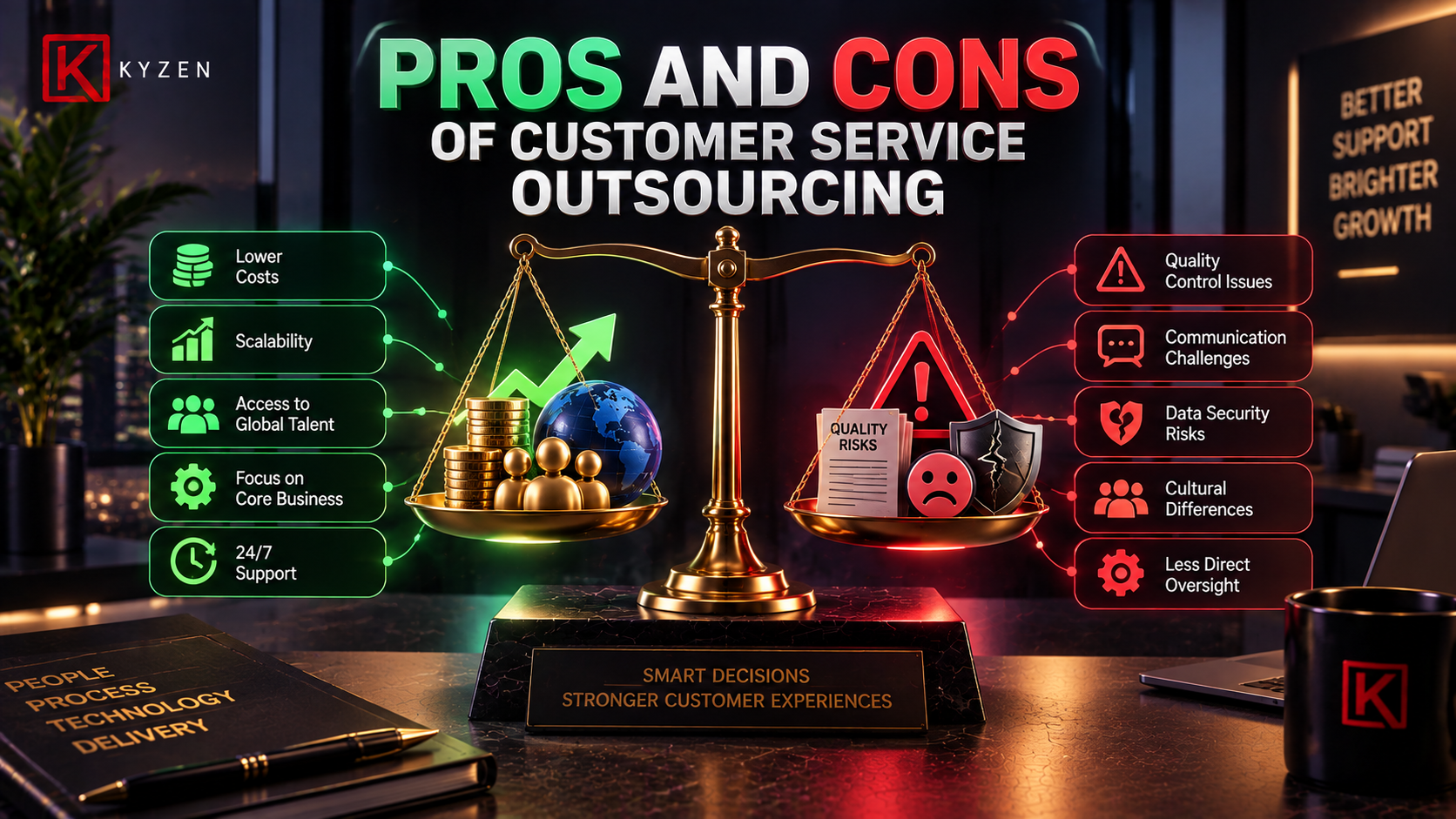
Most discussions of customer service outsourcing pros and cons stop at “lower costs” and “less control”. Neither tells an operations leader much about what will actually happen after the contract is signed.
The useful questions are more specific: Which costs disappear? What new ones appear? Where does product knowledge get lost? What happens when an escalation lands in the wrong time zone? Specialist providers such as KYZEN operate in environments where those details matter.
This guide looks at the mechanics behind the advantages and failure points, then compares in-house, BPO, and dedicated nearshore approaches.
What Is Customer Service Outsourcing?
Customer service outsourcing means contracting an external provider to handle some or all customer communication on your behalf. If you need the wider process, delivery models, and transition steps explained first, this guide on how to outsource customer service covers them in detail.
Pros of Outsourcing Customer Service
The strongest arguments for outsourcing are not abstract. They come from removing specific layers of cost, gaining capacity that already exists elsewhere, and accessing operating capability that would otherwise have to be built internally.
Cost Efficiency, Without Guessing at the Number
The savings do not come simply from paying an external agent less than an internal one.
An in-house support function also requires recruitment, onboarding, training infrastructure, workforce management, quality assurance, supervision, technology, and capacity planning. An outsourcing provider may already have those layers in place and spread them across a wider operation.
That difference is most significant when a company is building support from scratch or expanding rapidly. A business with an efficient, mature internal team may see a much smaller financial gap.
The right comparison is therefore total cost of delivery, not salary versus provider rate.
Scaling Without Fixed Headcount
Outsourcing can make capacity easier to add without immediately increasing permanent internal headcount.
Imagine an online business launches a major promotion and support volume jumps sharply for six weeks. An internal team may need to recruit, hire, and train additional employees after the spike has already started.
A provider with existing staffing, shift structures, or overflow capacity may be able to absorb part of that increase faster.
The same mechanism works in reverse. If demand falls again, the business is less likely to be left carrying a permanently enlarged team built for a temporary peak.
Specialized Expertise You Didn’t Have to Build
Established providers can bring training processes, QA frameworks, reporting structures and experienced agents that would take time to develop internally.
A managed standard support operation, for example, can include multilingual coverage, agent training, quality monitoring, escalations and reporting rather than simply supplying extra people.
That expertise should still be tested rather than assumed. Ask how agents are selected, how long training lasts, how quality is reviewed, and which cases first-line staff is authorized to resolve.
“Industry experience” means very little unless the provider can show how that experience changes its day-to-day operation.
Coverage Without Shift Premiums
Continuous coverage becomes expensive when you build it internally because the business needs more than agents working at night. It also needs supervision, handovers, absence cover, and enough capacity to keep service levels stable across several shifts.
Outsourcing can give the business access to standard casino support built around markets that do not stop when the local office closes.
The same issue appears in Forex, where customers may need support throughout the global trading week. The advantage is not that night or weekend labor becomes free. It is that the client does not have to construct and manage the entire multi-shift operation itself.
Cons of Outsourcing Customer Service
The downsides are equally concrete. Problems usually appear through poor coverage design, weak hiring, fragmented knowledge, or processes that were never properly documented in the first place.
The Timezone Escalation Gap
A support operation can technically be “outsourced” and still have gaps in real coverage.
Suppose an agent encounters an account issue at 02:00 local time, but the client’s specialist escalation team does not return until 09:00. The frontline response may be quick, yet the actual problem remains untouched for seven hours.
That is not necessarily an agent-quality problem. It is a coverage and handover design problem.
Before outsourcing, map not just frontline hours but also the availability of every team the provider may depend on for payments, compliance, risk, technical, or management escalations.
Language Screening Before Skills
Fluent language skills do not automatically produce accurate support.
Some delivery models place heavy emphasis on spoken or written language during recruitment because it is easy to test and immediately visible to customers. The risk is hiring people who communicate confidently but lack the product or domain understanding needed to make the right decision.
That becomes particularly costly in complex sectors.
Ask potential providers about the order of assessment. Do candidates demonstrate sector knowledge and problem-solving ability as well as language fluency? And what happens when an agent can explain an answer clearly but should not be making that decision at all?
Why Pooled Agents Lose Product Knowledge
A shared agent may handle several client accounts during the same week.
That makes capacity efficient, but it also divides attention. Product changes, promotions, policies, terminology, and exception cases from several businesses all compete for the same person’s memory.
A dedicated agent has more opportunity to let knowledge compound because the same product appears repeatedly in daily work.
That does not mean shared teams are inherently poor. They can work well for standardized, low-complexity queues. But as support becomes more technical, sensitive, or brand-specific, the knowledge advantage of a dedicated model becomes more important.
SOP Debt, Not the Vendor, Is the Blocker
Outsourcing often exposes process weaknesses that were already present internally.
An experienced employee might know, from habit, that a certain account problem should go to one particular team even though no written procedure says so. Once the work moves outside the company, that informal knowledge disappears.
The result is “SOP debt”: missing, outdated, or contradictory standard operating procedures that make consistent execution impossible.
This matters across business process outsourcing, not just customer support. Before blaming early provider performance, check whether the external team was actually given a complete process to follow.
If experienced internal employees solve exceptions from memory, those exceptions need documenting before handover.
Hidden Costs That Erase the Savings
A low service fee can become less attractive once transition costs are included.
Commonly missed costs include:
- documenting processes
- knowledge transfer
- systems access and integration
- agent training
- management time during ramp-up
- temporary quality deterioration
- ongoing vendor reviews
- escalation management
- changes outside the original scope
Specialized areas can carry further layers. Payment solutions, for example, can involve PSP assessment, sourcing, onboarding and ongoing payment coverage considerations beyond a simple staffing cost.
Ask prospective providers exactly what is included, what is chargeable separately, and what triggers a change in price.
What It Actually Costs, by Delivery Model
One average outsourcing rate is rarely useful.
A shared offshore queue, a dedicated multilingual team, and a nearshore specialist handling compliance-sensitive cases are different products with different cost structures. The delivery model determines what you are actually buying.

What a Dedicated Rep Actually Costs
Build the estimate from its components rather than searching for one universal hourly figure.
A dedicated representative’s effective cost may be thought of as:
Base staffing cost + location + language premium + domain expertise + operating hours + technology requirements + supervision + QA + account management
The more specialized the work becomes, the less useful a generic “agent rate” is.
For example, a team involved in payment orchestration needs operational knowledge of payment routing, PSP configuration, performance monitoring, and platforms such as PaymentIQ, Praxis, Corefy, or PayControl. That is different from staffing a basic FAQ queue.
Use current provider quotes for your market and scope rather than relying on a global average.
Why the Lowest Rate Isn’t the Lowest Cost
A cheaper hourly or per-ticket proposal can cost more if poor execution generates additional work.
Suppose Provider A charges less but customers contact support twice because the first answer does not resolve the issue. Provider B charges more per hour but resolves a much larger proportion of cases correctly on the first attempt.
The first proposal may still produce the higher total cost.
Compare:
Total support cost ÷ genuinely resolved issues
Then check that number alongside reopen rate, repeat contact, CSAT, and management time.
The lowest proposal should not automatically be assumed to have weaker hiring or higher turnover. Those are factors to verify. The point is that unit price alone does not measure delivery efficiency.
In-House vs Outsourced Support
In-house support offers direct oversight and deeper access to product context. Managers can coach employees immediately, and experienced staff often build valuable institutional knowledge over time.
The trade-off is a larger fixed-cost base. Recruitment, training, tooling, supervision, and coverage all remain the company’s responsibility.
Outsourcing shifts more of that operating structure to a third party. Capacity can be more flexible and specialist skills easier to access, but the business gives up some direct control and must manage the provider carefully.
The deciding question is therefore not “Which is better?” but which operating burden you are willing and equipped to own internally.
In-House vs BPO vs Dedicated Nearshore
There are more than two realistic options.
In-house gives the business maximum direct control and strong product context, but also requires the highest internal commitment to recruitment, management, systems, and capacity.
Shared BPO delivery can offer efficient capacity and rapid scaling because resources are spread across a larger operation. The trade-off is that individual agents may spend less time immersed in one client’s product.
Dedicated nearshore delivery places a dedicated person or team in a nearby region, often giving the client greater time-zone overlap and deeper account knowledge than a shared pool while still avoiding a fully internal build.
For a company evaluating crypto casino support, the relevant priorities might be language, payments knowledge, coverage, compliance awareness, and speed of escalation.
One clarification matters: BPO itself does not inherently mean “shared team”. A BPO provider may also offer dedicated delivery. Treat these as commercial models to compare rather than rigid categories.

Balancing In-House and Outsourced Teams
A hybrid model can divide work according to risk and complexity rather than forcing every interaction through one team.
Routine account queries, high-volume contacts, and after-hours queues may sit with an external provider. Complex complaints, highly sensitive cases, or interactions requiring deep internal judgment can remain in-house.
The two teams then need shared infrastructure around them:
- one current knowledge base
- clear ownership rules
- common quality standards
- agreed escalation paths
- shared ticket history
- regular calibration sessions
Without those links, customers experience two separate support organizations depending on which team receives the ticket. A hybrid model works only when the handoff feels invisible to the customer.
What to Outsource, and What to Keep
Use the interaction itself as the filter.
A strong outsourcing candidate is usually:
- repetitive
- well documented
- high volume
- measurable
- trainable
- governed by clear escalation rules
A stronger in-house candidate usually requires:
- deep product tenure
- sensitive judgement
- frequent consultation with senior internal teams
- direct product feedback
- unusual case-by-case discretion
- context that is difficult to document reliably
Do not classify work only by channel. Two live chats can carry completely different levels of risk.
Review actual ticket categories and ask: Could a well-trained external agent make the right decision from documented information alone? If not, keep or escalate that interaction internally until the process is mature enough.
Why SOP Debt Hits Regulated Support Hardest
Poor documentation causes problems everywhere, but the consequences increase when support sits close to compliance-sensitive workflows.
In a normal retail environment, an agent improvising around a missing procedure may give an inconvenient answer.
In iGaming or Forex, the same behavior could affect a KYC query, payment dispute, account restriction, or another case where the response needs to follow a defined process. A confident but inconsistent answer can create more than customer frustration.
That is why regulated businesses should document exceptions, decision boundaries, and escalation rules before transferring volume.
Performance trends can then be monitored through relevant customer support KPIs, such as FCR, reopen rate, escalation rate, resolution time, and CSAT, to identify where procedures are failing in practice.
Specific compliance requirements vary by jurisdiction and business model, so current obligations should always be checked for the markets involved.
Frequently Asked Questions
Is outsourced customer service cheaper than in-house?
It can be, but not in every case. The result depends on volume, location, team structure, and how much support infrastructure already exists internally. Compare total cost per genuinely resolved customer issue rather than relying only on salary or hourly provider rates.
Will outsourcing hurt customer satisfaction?
Not inherently. Satisfaction usually falls because of identifiable problems such as weak product knowledge, incomplete SOPs, poor escalation design, or inappropriate shared staffing. A specialist provider with strong training and quality controls can avoid many of these failure points.
What should stay in-house?
Keep interactions in-house when they require deep institutional knowledge, sensitive judgment, or a direct feedback loop with product and leadership teams. Routine, documented, and high-volume work is generally easier to transfer without losing important context.
Is customer service a stable field to build a partnership around?
Yes, provided the underlying operation is stable enough to transfer. The quality of the partnership depends heavily on documented processes, clear escalation paths, accurate knowledge, and regular performance reviews rather than outsourcing alone.
What’s the difference between BPO and dedicated nearshore outsourcing?
BPO describes outsourcing a business process and can use either shared or dedicated teams. Dedicated nearshore describes a specific delivery model: people assigned closely to one client from a nearby region, usually offering more time-zone overlap and account context than a shared pool.
When weighing customer service outsourcing pros and cons, the most useful question is not whether outsourcing is universally cheaper or better. It is whether your chosen delivery model gives you the right balance of cost, coverage, product knowledge, and control without creating more operational work than it removes.

